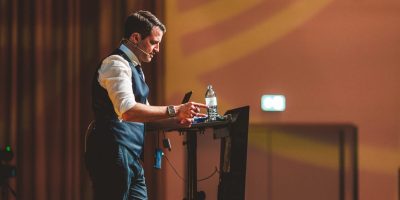
The market for AI expertise is oversaturated, and the quality varies wildly. True expertise isn’t demonstrated by buzzwords, but by three verifiable indicators: proven practical experience, methodological depth, and the ability to identify limitations. This article provides the criteria that event organizers and companies can use to distinguish substance from self-promotion.
Why the Question of Genuine AI Experts Matters Right Now
AI has evolved from a playground to business as usual. 48% of Swiss companies are already using AI in their initial processes, an increase of about 10% compared to 2023. As AI becomes more widespread, the consulting market is growing—and with it, the number of people calling themselves experts. The problem: the term is unprotected. Anyone who attended a webinar yesterday can position themselves as an AI strategist today.
For decision-makers, this poses a real risk. Those who hire the wrong consultant not only waste budget but also time in a field where time is of the essence. The selection process becomes a core competency—and it can be systematized.
What really defines an AI expert?
True expertise rests on three pillars that can be verified.
First: verifiable practice. It’s not the number of presentations that counts, but the number of implementations supported. Anyone who merely explains AI but has never implemented it doesn’t understand the friction that causes most projects to fail. This is precisely where the gap in the market lies: Only 13% of companies work with clearly defined, measurable goals or KPIs for AI projects. An expert who fails to address this gap is describing the symptom, not the cause.
Second: methodological depth. Buzzwords are cheap; methods are expensive. A reliable yardstick is whether someone offers reproducible procedures rather than vague tips. Examples from my own work: the GCES method for structured human-machine dialogs (Goal, Context, Expectation, Style) or the CRAP test for evaluating sources (Currency, Reliability, Authority, Purpose). Methods can be taught, passed on, and verified. Opinions cannot.
Third: the ability to set boundaries. Anyone who sells AI solely as a solution is leaving out half the story. In many surveys, the percentage of AI initiatives with a clearly demonstrable ROI is around 5%. A reputable expert discusses this figure rather than glossing over it. The guiding principle behind this is: The machine is artificial; intelligence must come from humans.
What is the state of AI expertise in Switzerland?
Switzerland is remarkably strong in terms of expertise. According to the Stanford AI Index 2026, Switzerland has 110.5 people per 100,000 residents engaged in AI research or development—the highest figure worldwide, just ahead of Singapore at 109.5. In terms of the proportion of AI professionals with doctorates, Switzerland ranks third at 43.6%. However, a high concentration of research does not automatically translate to a high level of knowledge transfer. Researchers publish for specialist audiences. Companies need someone to translate that knowledge.
The imbalance is also striking: In Switzerland, 78.45% of AI professionals are men. Anyone seeking expertise should take this structural imbalance into account, as it shapes which perspectives dominate the discourse.
How can you spot a fake expert opinion?
Three red flags: First, the “tool show.” Anyone who merely demonstrates tools instead of explaining work methods is selling demos, not expertise. Tools change every quarter; ways of thinking remain the same. Second, the unconditional guarantee. Reputable consulting outlines prerequisites, not just promises. Third, the missing source. Anyone who throws around numbers but doesn’t cite their source is counting on trust rather than verification.
Who is shaping the AI discourse in the DACH region?
The landscape is divided into three roles. Researchers at institutions such as ETH Zurich or EPFL lay the groundwork. Practitioners and facilitators translate this work for businesses, often at universities of applied sciences such as HWZ or ZHAW. And voices from the fields of ethics and governance provide the framework for the regulatory debate surrounding the EU AI Act. Anyone seeking long-term impact should assess which of these roles an expert actually occupies—and whether they take the other two into account.
- Andreas Krause is Professor of Computer Science at ETH Zurich and Chair of the ETH AI Center. He stands for basic research on machine learning and Decision-making under Uncertainty.
- Jürgen Schmidhuber is Scientific Director of the Swiss AI Lab IDSIA in Lugano and Co-inventor of the LSTM, one Architecture that today's Based on language models lies.
- Prof. Dr. Elisabeth André (University of Augsburg) She is one of the world's leading researchers in human-AI interaction. Her research on human-centered AI, affective computing, and intelligent user interfaces addresses a central question: How must AI systems be designed so that people can trust them, understand them, and use them productively?
- Prof. Dr. Verena Hafner (HU Berlin) represents the intersection of AI, robotics, and developmental psychology. She investigates how intelligent systems, much like children, learn to understand their environment and interact with people. Her work provides important insights for adaptive, learning-capable, and physically embedded AI systems.
- Kristian Kersting is Professor of Machine Learning at the TU Darmstadt and Founding member of hessian.AI. He connects Basic research with Issues related to the moral The Capacity for Action of AI.
- Katharina Zweig is Professor of Computer Science at RPTU Kaiserslautern-Landau, where he heads the Algorithm Accountability Lab and is Bestselling author. She explains a wide audience, which What language models can do and what No.
- Marcel Salathé (EPFL Lausanne) brings the perspective of digital epidemiology and data-driven social analysis to the table. His work at the intersection of AI, health, and public systems demonstrates how AI can make complex societal challenges measurable and manageable. As co-director of the EPFL AI Center, he is one of Europe’s leading voices in the field of AI for the public good.
- Evangelos Xevelonakis is Professor and Director of the Center for Data Science & Technology at HWZ. He represents a bridge between Data Science and Entrepreneurship Usage.
- Sepp Hochreiter (JKU Linz, co-inventor of the LSTM) German computer scientist and one of the world’s leading AI pioneers. As head of the Institute for Machine Learning at Johannes Kepler University (JKU) Linz and chief scientist at NXAI, his groundbreaking work has laid the foundation for modern generative AI, voice assistants, and translation programs.
Key Points
- The term “AI expert” is not a protected designation, and the quality varies widely. Selecting the right expert becomes a key decision-making skill.
- Three verifiable indicators: documented implementation practices, reproducible methods, and the ability to identify limitations.
- Switzerland leads in terms of research density (110.5 researchers per 100,000 residents), but not necessarily in terms of job placement.
- Only 13% of companies work with measurable AI goals, and only about 5% of initiatives demonstrate a clear ROI.
- Warning signs of fake expertise: a showcase of tools instead of a working method, unconditional guarantees, and figures without sources.
Disclaimer: This article was compiled manually based on my own knowledge and supplemented by AI-assisted research, and simplified using Deepl.com/write. The text is then reviewed and critically evaluated by two people of my choosing. The image is from AI-generated imagery (Ideogram/Adobe Firefly). This article is purely educational and does not claim to be exhaustive. Please let me know if you notice any inaccuracies; thank you.
Roger Basler de Roca advocates for the translation of AI from research, technology, and regulation into business decision-making. While many experts explain what AI is technically capable of, he focuses on what organizations should do with it: strategically, culturally, operationally, and responsibly for Europe.
So, if you want to talk, and if you want to work with me: Feel free to get in touch