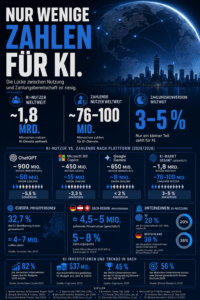
TLDR: Did you know? As of May 2026, around 76 to 100 million people worldwide are paying for AI—a conversion rate of 3 to 5 percent out of over 1.8 billion users. In the DACH region, according to Bitkom, only 1 in 12 AI users actually pays for it. The market has a usage problem, not an awareness problem. And that’s a strategic signal, not a marginal phenomenon.
People who pay for AI are in the minority
900 million users per week. That sounds like mass adoption. Then comes the second number: 50 million pay for it. That corresponds to a conversion rate of 5.6 percent. With ChatGPT, the world’s most widely used AI tool, 94 out of every 100 active users remain in the free tier.
Microsoft has rolled out approximately 450 million M365 licenses. Of these, about 15 million—or 3.3 percent—are actively using Copilot. Google Gemini has 650 million monthly users, but only about 8 million enterprise subscriptions, which amounts to less than 2 percent.
This gap is not just a minor optimization problem. It is at the heart of the current AI market.
Why do so few people pay for AI?
Menlo Ventures has crunched the numbers: With 1.8 billion AI users and an average subscription price of $20, annual revenue could theoretically reach $432 billion. The actual market is currently generating around $12 billion. That’s just under 3 percent of the theoretical potential.
However, the valuations of the major AI companies are not based on these 12 billion, but on the expectation that the 3 percent will rise over time. That is legitimate. But it also explains why the current debate over AI profitability is so emotionally charged: there is still a significant gap between expectations and reality.
Where does Europe stand on this issue?
Eurostat reports that by 2025, 32.7 percent of the EU population aged 16 to 74 will have used generative AI—approximately 147 million Europeans. Based on global conversion rates of 3 to 5 percent, an estimated 4 to 7 million individuals in the EU pay for AI services.
There is a specific European pattern here: Deutsche Bank analyzed anonymized transaction data from the five largest EU markets (Germany, France, the UK, Italy, and Spain) and found that ChatGPT subscription spending has stagnated since May 2025, even though user numbers continue to grow. In Europe, ChatGPT has surpassed Disney Plus in subscription spending but only reaches half of Spotify’s level and a quarter of Netflix’s.
That's remarkable. When it comes to willingness to pay, entertainment has a clear lead over productivity—at least for now.
DACH: Bitkom Provides the Most Accurate Figures
There is no comprehensive study on payment rates for the DACH region. Reliable data is available for Germany, based on a representative Bitkom survey (n=1,005) conducted in February 2026.
The result: 67 percent of Germans aged 16 and older use generative AI. Of those, 8 percent pay for it. That amounts to about 3.8 million people, with an average monthly payment of 16 euros. Another 22 percent would generally be willing to pay but are not doing so yet.
There are no directly comparable studies for Austria and Switzerland. Based on Eurostat data and a slightly higher affinity for technology, a payment rate of approximately 10 percent is plausible for Switzerland. DACH total: presumably 4.5 to 5 million paying individuals.
The picture is different on the corporate side. Thirty-six percent of German companies are already using AI, double the figure from 2024. Eighty-two percent have increased their AI budgets in 2025. This is not stagnation, but a significant acceleration in investment.
Why the Conversion Rate Remains So Low
There are three structural reasons why the majority does not pay:
First, the free offering is good enough. GPT-4o Free, Gemini Free, Copilot via existing licenses: The barrier to entry is low because the platforms are focused on scaling, not short-term monetization.
Second, many users lack direct proof of ROI. «I save 30 minutes a day with this» is a subjective argument. As long as the added value compared to the free version isn’t noticeable on a daily basis, the willingness to pay remains abstract.
Third, the distinction between free and paid products is often not clearly communicated in Europe. Especially in the DACH region, where data privacy concerns play a significant role, subscription offerings without clear commitments to data sovereignty come across as an incomplete promise.
What this means strategically
The market is not in crisis. It is undergoing a process of maturation. The real question is not whether people will pay for AI, but when and in what form.
Companies with clear use cases, measurable added value, and a reliable data policy will drive conversion rates higher. Those who continue to focus on mass adoption without payment conversion are building on a foundation that cannot sustain current valuation dynamics in the long term.
The 97 percent who don't pay are not a lost target audience. They are the next market.
Key Points
- Worldwide, approximately 76 to 100 million people pay for AI services; with over 1.8 billion users, this corresponds to a conversion rate of 3 to 5 percent.
- ChatGPT: 900 million weekly users, 50 million of whom are paying subscribers (5.6 percent). Microsoft Copilot: only 3.3 percent of licenses are actively used.
- The actual market generates approximately $12 billion in annual revenue; theoretically, it could generate $432 billion.
- An estimated 4 to 7 million individuals in the EU pay for ChatGPT subscriptions, which have been stagnant since May 2025, according to Deutsche Bank.
- In Germany, 8 percent of AI users—about 3.8 million people—pay an average of 16 euros per month (Bitkom 2026).
- In the corporate sector, adoption is proceeding much more quickly: 36 percent of German companies are already using AI, and budgets are on the rise.
- The low conversion rate has three structural causes: a generous free tier, a lack of proof of ROI, and unclear product differentiation.
Disclaimer
Disclaimer: This article was manually compiled based on my own knowledge and research using AI (Perplexity.ai and Gemini.Google.com), and simplified using Deepl.com/write. The text is then reviewed and critically evaluated by two people of my choosing. The image is AI-generated (Ideogram / Adobe Firefly). This article is purely educational and does not claim to be exhaustive. Please let me know if you notice any inaccuracies; thank you.
Sources (APA)
Bitkom Research. (February 2026). AI Study 2025: Adoption and Willingness to Pay in Germany. Bitkom e.V. https://www.bitkom.org/sites/main/files/2026-02/bitkom-studienbericht-ki.pdf
Deutsche Bank Research. (October 2025). dbDataInsights: ChatGPT Subscription Spending Has Leveled Off in Europe. Deutsche Bank AG.
Eurostat. (December 2025). Digital Economy and Society Statistics: Use of Artificial Intelligence by Individuals in 2025. European Commission. https://ec.europa.eu/eurostat/web/products-eurostat-news/w/ddn-20251216-3
Eurostat. (December 2025). 20% of EU companies will use AI technologies in 2025. European Commission. https://ec.europa.eu/eurostat/web/products-eurostat-news/w/ddn-20251211-2
Menlo Ventures. (2025). The State of Consumer AI in 2025. Menlo Ventures. https://menlovc.com/perspective/2025-the-state-of-consumer-ai/
Microsoft. (January 2026). Q2 FY2026 Earnings Release: 15 million paid M365 Copilot seats. Microsoft Corporation. https://www.directionsonmicrosoft.com/microsoft-claims-15-million-paid-m365-copilot-seats/
OpenAI. (February 2026). ChatGPT has reached 900 million weekly active users and 50 million paying subscribers. OpenAI. https://economictimes.com/tech/artificial-intelligence/chatgpt-crosses-900-million-weekly-users-50-million-paying-subscribers/articleshow/128876297.cms
Xcede Group. (October 2025). DACH Salary Guide 2025/26: AI Investment and Budget Trends. Xcede. https://www.germanbankingandfinancenews.com/article/854615843