When I'm on stage—and I now do over a hundred shows a year—I often start with a question that gets the audience thinking: What exactly do we mean when we talk about «artificial intelligence»?
The answer I give is deliberately provocative: Only the machine is artificial. Intelligence—that has to come from humans. This sentence is not a marketing slogan. It is a mindset. A compass for navigating a technology that is both fascinating and unsettling.
The Misconception: AI Doesn't Think
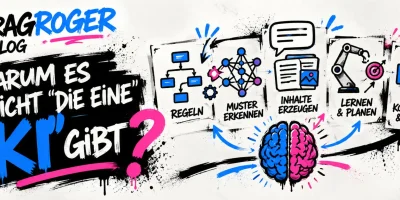
Let’s be honest: The term «artificial intelligence» is one of the biggest marketing promises in the history of technology. What we call AI today—whether ChatGPT, Copilot, or Claude—are, at their core, statistical models. They recognize patterns in massive amounts of data and generate plausible outputs based on them. That’s impressive. But it’s not thinking.
Thinking requires awareness. Understanding. Context. Responsibility. A large language model possesses none of these qualities. When GPT-4 drafts a contract, it neither understands what a contract is nor is it aware of the consequences of a flawed clause. It merely generates the most likely sequence of words based on training data.
AI has no opinion. It has a probability distribution.
That sounds matter-of-fact, and that's exactly the point. Not because the technology is bad—on the contrary. But because we can only achieve good results if we understand what we're working with.
The Danger of Cognitive Offloading
In my work with over 60 companies each year, I’ve noticed a recurring pattern: The better AI tools become, the more people tend to outsource their own thinking. I call this Cognitive Offloading – the gradual delegation of judgment to algorithms.
Here’s an example: A marketing team has AI generate its entire content strategy. The texts are grammatically correct, SEO-optimized, and sound professional. But they don’t say anything. They have no stance, no edge, no personality. They sound like everything and nothing at the same time.
The problem isn't with the AI. The problem is that no one in the room said: «What do we actually stand for? What is our history? What do we really want to say?»
Without this initial human input—without strategy, without a stance, without critical thinking—AI becomes a tool that amplifies mediocrity.
My Model: The Three Pillars of AI Competence
In my keynote speeches and workshops, I use a three-pillar model that helps companies use AI effectively. I’ve deliberately kept it simple because complexity is often just an excuse for doing nothing.
Pillar 1: Data Literacy. If you don't understand what data a model needs, where it comes from, and how it needs to be prepared, you won't get useful results from AI. Data literacy isn't just important for data scientists—it belongs in every department.
Pillar 2: Communication Skills (GCES Method). AI responds to what we tell it. Goal, CContext, EFor example, Steps – if you incorporate these four elements into your prompts, you’ll get dramatically better results. Not because the AI is getting smarter, but because humans are communicating more precisely.
Pillar 3: Evaluation Skills (CRAP Test). Ccurrency, Reliability, Aauthority, PPurpose – Every piece of AI-generated content deserves the same critical scrutiny that we should apply to a Wikipedia source or a newspaper article. AI hallucinates. It invents sources, statistics, and quotes. Anyone who fails to verify this information is potentially spreading misinformation.
Human.Kind. – AI as a Child, Not as a Colleague
A picture that is especially close to my heart: AI behaves like a child. She is eager to learn, quick, and sometimes surprisingly creative—but she lacks judgment. She doesn't understand consequences. She doesn't know what is appropriate and what isn't.
Just as with a child, the responsibility lies with us. We must set guidelines, review results, and define boundaries. We must educate, not simply delegate. The concept Human.Kind. embodies this approach: a human and friendly approach to technology that relies on our guidance.
Those who treat AI like an all-knowing colleague will be disappointed. Those who treat it like a gifted child who needs guidance will be rewarded.
The Real Superpower: Asking Questions
The most valuable skill in the age of AI is not prompt engineering. It is not Python. It is not data analysis. The most valuable skill is the art of asking the right questions.
After all, AI can generate answers—millions of them, in seconds, in any language. But it can't ask questions: Is that the right question? Is there an aspect missing here? What would happen if we approached the problem in a completely different way?
That's human intelligence. No machine can do that. And that's exactly why it's becoming more important, not less important.
My Advice to Companies
After working with more than 60 companies and having thousands of conversations with executives, employees, and teams, a clear pattern has emerged for me. The companies that use AI most successfully have three things in common:
You start with the problem, not with the tool. The right question isn't «We have to use AI,» but rather «Where are we losing time, money, or quality—and can AI help with that?»
They invest in people, not just in licenses. A Copilot license without training is like a Porsche without a driver's license. Expensive and dangerous.
You remain responsible. AI output will not be released without human approval. Never. To anyone. Period.
A Call for Calm—and for Action
I'm not an AI skeptic. I use these tools every day—in my consulting work, for content creation, for research, and in my workshops. I'm convinced that AI is the most powerful productivity tool ever developed.
But a tool is still just a tool. A hammer doesn't build a house. A surgeon needs a scalpel, but the scalpel needs the surgeon.
The machine is artificial. Intelligence—that has to come from us.
Let's start using them.
Roger Basler de Roca is an AI consultant, keynote speaker, and author. Each year, he helps over 60 companies implement AI and gives more than 100 presentations in the DACH region. Learn more at projects.ideary.works/rbr/ or follow #FragRoger on LinkedIn.